
Over the past few months, I’ve talked quite a bit about wanting ExitLab to become more than just a series of projects. I want it to become a way of working. Instead of guessing, I want to test. Instead of assuming, I want to measure. And instead of trying to read my way to every answer, I also want to build my own experience.
That’s how this small side project came about—a mini ExitLab experiment running alongside the larger, more official projects.
I’m far from an expert on social media. In fact, I didn’t really start using Pinterest until I launched Hamster Wheel Exit. I’ve skimmed guides and looked at what other creators recommend, but sooner or later you reach a point where you simply have to test things for yourself.
That’s exactly what I wanted to do.
Why Pinterest?
I chose Pinterest because it behaves more like a visual search engine than a traditional social media platform. Unlike platforms where a post often disappears within hours, Pinterest content can continue generating traffic weeks, months or even years later.
That long-term perspective fits both Hamster Wheel Exit and the way I prefer to build things.
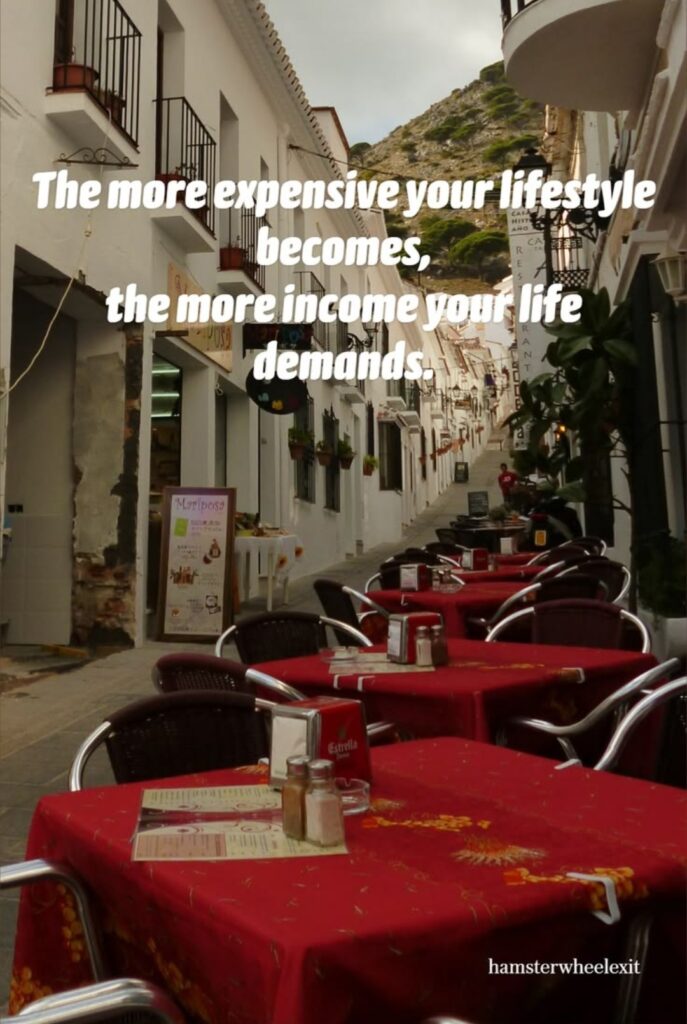
Before we get into the numbers, here’s one of the pins that unexpectedly performed far better than I anticipated:
The Goal
The goal was simple.
- Learn how Pinterest works for a small account.
- Increase traffic to my blog.
- See whether consistency alone could help Pinterest understand my content.
Experiment Setup
The original plan was to run the experiment for eight weeks. I only managed to almost complete week seven. During the final weeks, my regular job became too demanding and I had to prioritize other things.
Here’s how the experiment was designed:
- Duration: Almost seven weeks
- Publishing schedule: Two new pins almost every weekday (7:00 AM and 12:00 PM)
- Strategy: Four recurring pin formats
- Objective: Test whether repeating a small number of content formats would help Pinterest understand what my account was about.
To avoid publishing the same combination throughout the experiment, I rotated the four pin formats according to a fixed schedule.
| Weeks | Pin formats |
|---|---|
| 1–2 | A + B |
| 3–4 | A + C |
| 5–6 | C + B |
| 7 | D + C |
My Hypothesis
My assumption was straightforward.
If I consistently published the same four types of pins over several weeks, Pinterest’s algorithm would gradually understand what my account was about and start showing my content to more people interested in those topics.
It sounded reasonable.
Reality had other plans.
The Results
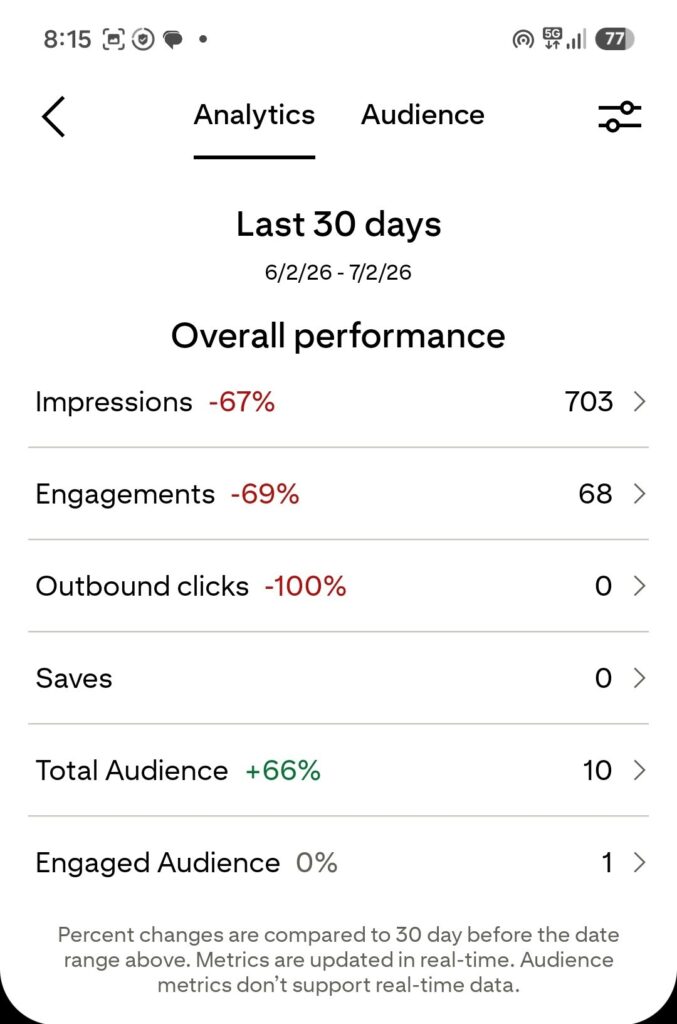
After almost seven weeks, the numbers looked very different from what I expected.
- Impressions: -67%
- Engagements: -69%
- Total audience: +66%
That wasn’t the outcome I expected.
Something Else Surprised Me
Another interesting thing happened during the experiment.
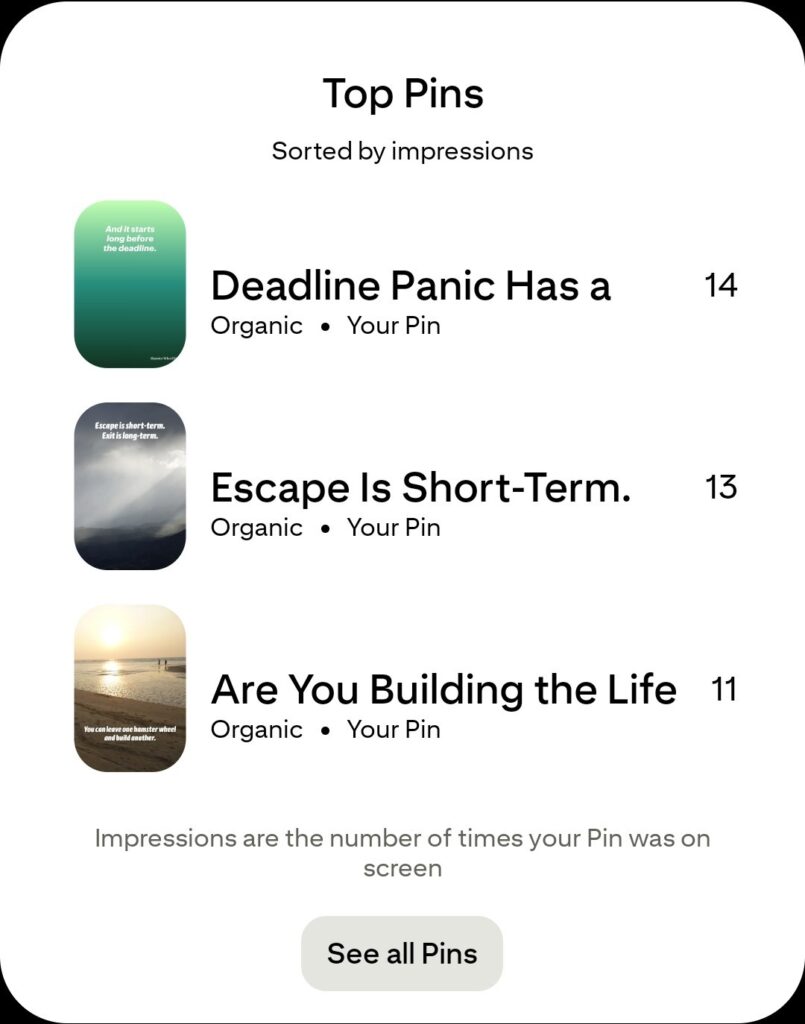
The pins that performed best weren’t always the same.
A few weeks ago, completely different pins topped the list. Later, new ones replaced them.
Success on Pinterest doesn’t seem to be static—at least not for a small account like mine.
The platform appears to keep testing different pieces of content over time.
Why Did Some Pins Perform Better?
I honestly don’t know.
Was it the image, the overlay text, the topic, the combination of image and copy, the algorithm—or simply timing?
One of the strongest-performing pins combined a photo that matched the message perfectly with a headline built around an insight rather than a practical tip.
Was that the reason?
Maybe.
Maybe not.
At this point I simply don’t have enough data to know.
A New Hypothesis
Although my original hypothesis didn’t hold, the experiment gave me a new one.
Perhaps consistency isn’t the most important factor when a Pinterest account is still very small.
Perhaps a broader approach works better.
Instead of repeatedly showing Pinterest four content formats, maybe I should give the algorithm a much broader variety of content and let it discover what resonates with readers.
One experiment doesn’t prove anything. But it can point you in a new direction.
That will be the focus of the next experiment.
Pinterest Experiment #2
Pinterest Experiment #2 begins later in July.
This time I’ll test a much broader content strategy with more topics, more creative angles and a wider variety of pins.
We’ll see if the results change.
ExitLab Logbook
Hypothesis
Four recurring pin formats would help Pinterest understand my account.
❌ Result
My hypothesis wasn’t supported.
What I learned
My audience became more relevant, but my reach dropped significantly. The strongest-performing pins also changed over time, raising new questions rather than providing clear answers.
Next Experiment
A broader Pinterest strategy with more content variety.
Final Thoughts
This experiment also made me realize something else.
ExitLab itself is beginning to take shape. When I first introduced the idea earlier this year, I mostly saw it as a collection of projects. Now it feels more like a framework—a way of testing ideas, documenting the results and letting one experiment lead naturally to the next.
If I bring this back to the bigger idea behind ExitLab, I’ve realized something important.
Maybe the most valuable part of an experiment isn’t finding answers.
Maybe it’s leaving you with better questions than you had when you started.
If you’d like to follow the next experiment as it unfolds, you can also find me on Pinterest.